Kashmir · An eighth-century temple near Anantnag
Martand Sun Temple
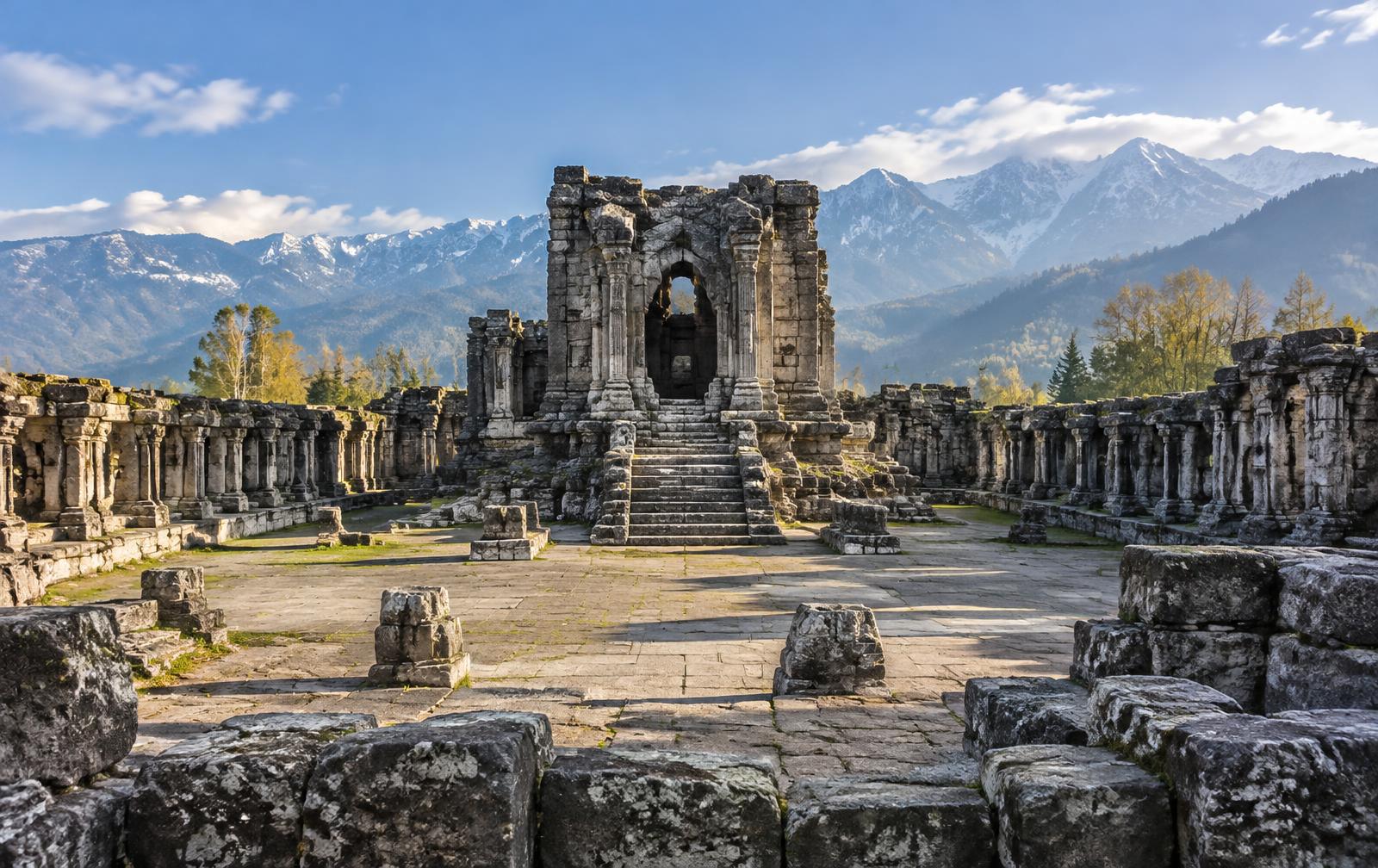
A monumental stone courtyard whose broken colonnades still frame the mountains and the open sky.
A little history
The place behind the view
Built in the eighth century under the Karkota ruler Lalitaditya Muktapida, Martand was dedicated to Surya, the sun deity. Its surviving central shrine, courtyard, and surrounding colonnade reveal the ambition of early medieval Kashmiri architecture. The remains also point to the cultural connections and royal patronage of the Karkota period.
At Martand, setting and architecture seem to speak to each other. The temple occupies open ground with expansive views, and the repeated stone openings frame mountains and sky in changing ways as I move through the courtyard. Even in ruin, the plan has remarkable clarity. I can imagine the central shrine as the focus of a carefully ordered sacred enclosure.
The surviving stonework invites close attention to proportion as much as ornament. Massive blocks, recessed arches, pilasters, and column bases create a language that feels distinct from the temple traditions I have seen elsewhere in India. Martand reminds me that Kashmir was an important centre of architectural innovation, connected to wider artistic currents while developing forms suited to its own culture and materials.
I do not try to complete the missing roof or imagine away the damage. The broken silhouette has its own honesty, allowing me to think about time, changing political worlds, and the vulnerability of even the most ambitious stone buildings. Yet the site is not only about loss. Its continued power lies in how strongly the original vision still organizes the space and holds the surrounding landscape.
“The open sky is part of the experience here. Standing among the stone columns, I feel the scale of the place and the patience that went into shaping it. Its quiet is powerful, not empty.”Read the historical source: Incredible India — Martand Sun Temple