Rajasthan · A planned city, founded 1727
Jaipur
Rose-coloured streets, astronomical instruments, and a craft tradition that still fills the old city.
A little history
The place behind the view
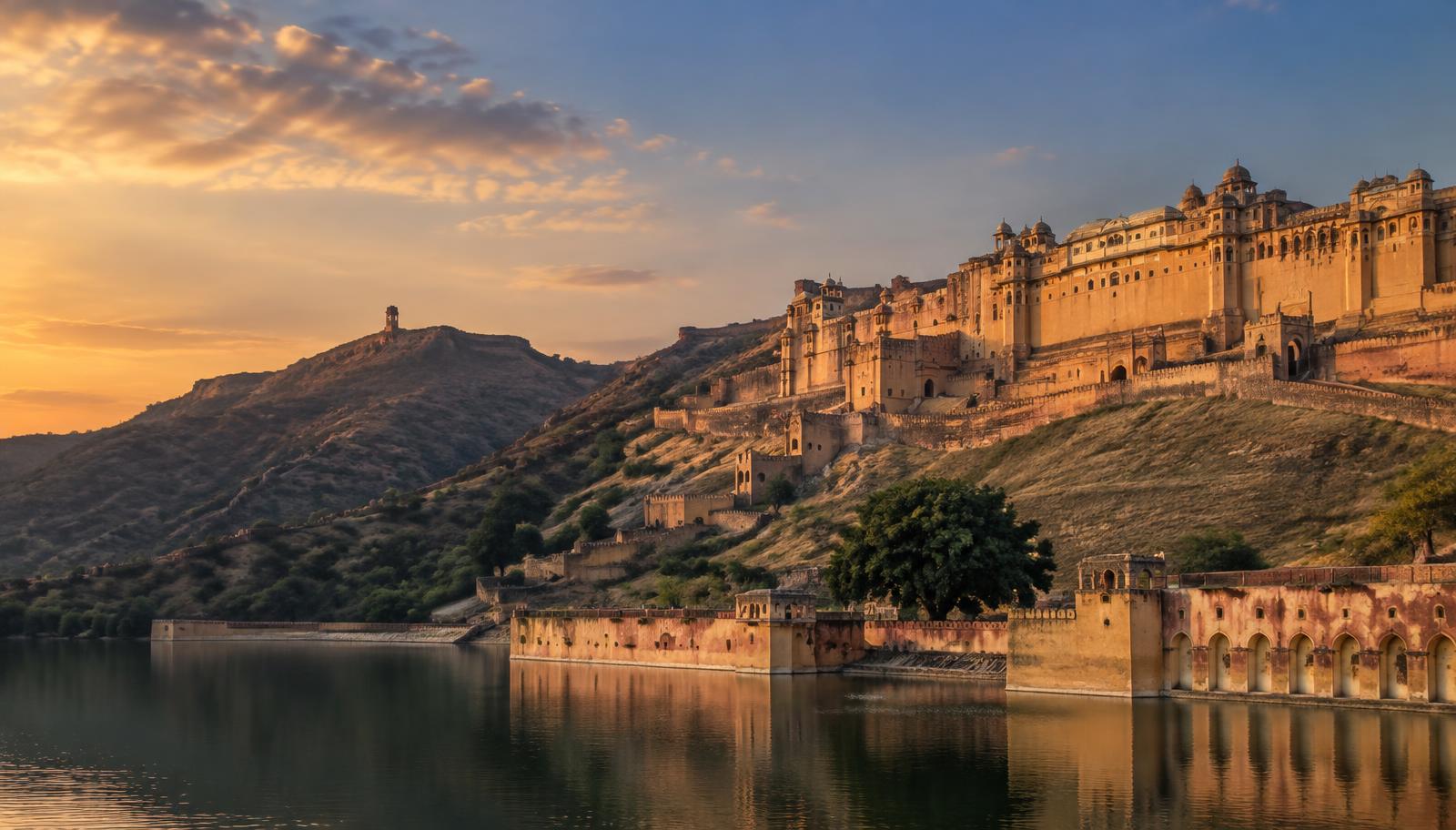
Sawai Jai Singh II founded Jaipur in 1727 and moved his capital here from Amber. Its walled centre was laid out on a deliberate grid, shaped by contemporary planning ideas, Vastu Shastra, and the city's role as a centre of trade. The City Palace and Jantar Mantar express the same combination of royal ambition, scientific curiosity, and public life.
I like beginning in Jaipur on foot, before the traffic gathers pace. At street level, the famous pink façades are not a backdrop; they are the edges of an active city. Sweet shops open their shutters, flower sellers work near temple doorways, and repeated arches lead the eye towards another busy crossing. The uniformity of the old streets makes every small variation—a painted doorway, a carved balcony, a brass vessel in a window—worth noticing.
At Jantar Mantar, I slow down for a different reason. The monumental instruments turn the movement of the sun and stars into something you can walk around. They remind me that Jai Singh's city was not only concerned with defence and commerce; it also made room for observation and inquiry. Nearby, the City Palace brings together courtyards, gateways, textiles, and objects of courtly life, each adding another layer to the story of the Kachhwaha rulers.
What completes Jaipur for me is the work of its makers. Block printing, gemstone cutting, blue pottery, and jewellery are not decorative footnotes to the monuments. They connect the city to networks of skill and exchange that long outlasted a single reign. Leaving the old bazaar, I carry the impression of a capital whose original plan is still visible, but whose everyday culture keeps rewriting the streets.
“Jaipur's order feels different from the accidental beauty of an old city. The broad streets make the plan visible, while workshops and markets fill that order with colour, sound, and human movement.”Read the historical source: UNESCO — Jaipur City